

On 19 November 2025, a special debate was held to accompany the premiere of the award-winning film “The Altar Boys”, directed by Piotr Domalewski (winner of numerous awards, including the Golden Lions). The meeting of experts and commentators went beyond the framework of film promotion, becoming one of the most powerful voices in the discussion about the condition of the Church in Poland.
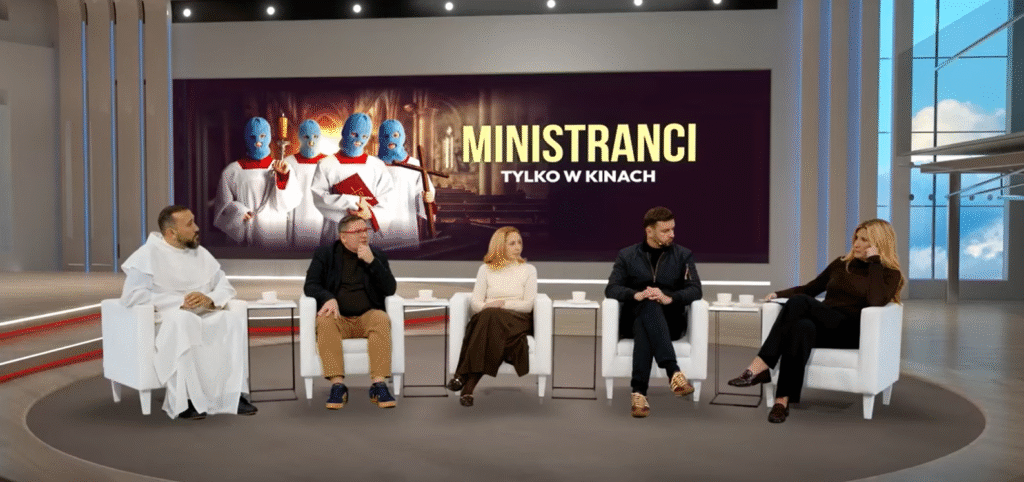
Moderated by Magdalena Rigamonti, the discussion – featuring Dominika Wielowieyska, Fr Michał Legan OSPPE, Tomasz Terlikowski and the director, Piotr Domalewski – focused on young people drifting away from faith, the seal of confession and the political exploitation of religion.
Tomasz Terlikowski: “I believe this film should be seen by priests, that is the first element; it should be seen by parents, so that they can confront their own parenting, mothers and fathers alike; and it should be seen by teachers.”
Required viewing for priests
The most heated moment of the debate centred on the question of who “The Altar Boys” puts in the dock. The film tells the story of a group of teenagers who plant a listening device in a confessional in order to mete out their own justice, frustrated by the indifference of adults.
Fr Michał Legan agreed with Tomasz Terlikowski: “Tomek is right that every Polish priest should see this film. What is more, we should use this film to make an honest examination of conscience, and that would be great.”
The discussion quickly moved on to the role of parents and teachers. Fr Michał Legan added a psychological perspective that speaks to every adult viewer: “Why should parents see it? So that we remind ourselves of a simple truth. It resonated
with me very strongly as I watched this film: that childhood is a very difficult moment in life, that being a child is something unimaginably hard.
Hypocrisy and a crisis of faith
The experts analysed how the phenomenon of secularisation correlates with disillusionment with the institution. Dominika Wielowieyska strongly emphasised the loss of trust.
Dominika Wielowieyska: “The Church is not credible. People are leaving because what they hear from the pulpit and what they see in real life simply do not match. Young people do not see the credibility the Church should have. They believe the Church has become an institution of power, wealth and hypocrisy, rather than an institution of spirituality.”
Tomasz Terlikowski argued that the film debunks the illusion surrounding the so-called “JPII generation”: “The Church believes it is dealing with the generation raised by John Paul II. And suddenly it turns out that this generation is just as lost and confused as any other.”
Finally, Fr Michał Legan balanced the narrative by recalling the Church’s charitable work: “You cannot speak about the Church so one-sidedly. It is a community that continually carries out enormous missionary and aid works, such as hospices. It runs hospitals, it runs children’s homes. Evil is not justified by anything. But for the sake of the full picture, I felt obliged to mention this as well.”
The appeal of the debate participants is clear: this is a film for anyone who wants to understand where the Polish Church is heading and what the rebellious young generation feels.
The full recording of the debate:
Debate participants:
* Fr Michał Legan
* Piotr Domalewski
* Dominika Wielowieyska
* Tomasz Terlikowski
* Magdalena Rigamonti (moderator)
Author: Kalina Wyszyńska


