

“The Peasants”, a unique painted animation and the film event of the autumn, opens in cinemas on 13 October. The world premiere of the film directed by DK Welchman and Hugh Welchman (“Loving Vincent”) will take place at the prestigious Toronto International Film Festival on 8 September. The extraordinary adaptation of Władysław Reymont’s Nobel Prize-winning novel has also been selected for the London Film Festival (4–15 October). It is screening in the Dare strand, which the organisers themselves describe as a place of provocation, confrontation and boundary-pushing. Today we unveil the film’s poster.
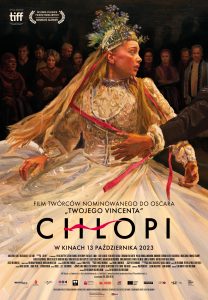
The poster was created by DK Welchman and Michał Janicki.
Why did the filmmakers turn to the painted animation technique once again while working on the adaptation of “The Peasants”?
– We were looking for a follow-up for painted animation, and we didn’t want to make “Loving Vincent 2”. We wanted to explore what this technique can do — so why not adapt a 1,000-page novel into a film running under two hours? – says Hugh Welchman.
DK Welchman adds: – Painted animation allows us to create a world you can immerse yourself in and feel. The technique we chose makes it possible to convey the fast-paced action of Reymont’s novel with the full richness of the actors’ performances, and to capture the nuances of nature. A description of the landscape running several pages can be rendered in a single image.
“The Peasants” is nominated for the Golden Lions in the Main Competition of the Polish Film Festival in Gdynia. The gala screening will take place on 19 September.
THE “PEASANTS IN THE ARCHIVE” EXHIBITION
Meanwhile, from 8 September to 31 October, the open-air exhibition “The Peasants in the Archive”, organised by the State Archive in Warsaw in cooperation with Breakthru Films, will be open to visitors. It can be viewed free of charge on the walls of Warsaw’s Barbican. The archival materials presented on the exhibition boards come from the holdings of the State Archive in Warsaw. Breakthru Films has provided stills from “The Peasants”.
Władysław Reymont’s novel was regarded by many foreign reviewers as a guide to the Polish soul — to our customs, traditions and demons. The exhibition juxtaposes stills from the animated “The Peasants” with documents, registers, photographs, newspapers, paper cut-outs and postcards. Together they tell the story of that era and its people: the life of the peasants and their folklore, social change, Reymont himself, and the art of Young Poland, which left a clear mark both on the novel’s author and on this latest screen adaptation.
The State Archive in Warsaw is an institution whose roots go back to the 18th century. It is based at 7 Krzywe Koło Street in Warsaw’s Old Town (more information: warszawa.ap.gov.pl). In its reading room, visitors can consult historical documents and books useful for genealogical, property and academic research. In addition to its research and educational activities (archive lessons), it carries out record searches. It also popularises the archival materials held in its collections and prepares exhibitions based on them, available for loan free of charge.
On Friday 8 September, in addition to the opening of the open-air exhibition “The Peasants in the Archive” at the Warsaw Barbican at 2 p.m., the State Archive in Warsaw also invites visitors to its headquarters at 7 Krzywe Koło Street. On that day you will be able to see there, displayed in cabinets, the original materials — documents, registers, photographs, newspapers, postcards, paper cut-outs — that were used to create the “The Peasants in the Archive” exhibition.
* * *
THE PEASANTS
Premiere: 13 October
Synopsis: Set against the backdrop of the changing seasons and seasonal field work, the story follows the fortunes of the Boryna family and the beautiful, mysterious Jagna. It is the women — above all the tragic figure of Jagna — who stand at the heart of the plot. The unique microcosm of a village community becomes the starting point for a universal and remarkably timely story. A story of tragic love and life in a small community, where rules and the brutal laws of the game assign everyone a fixed place in the group, and stepping outside those narrow confines risks humiliation and rejection.
The film draws on the painting of the Young Poland period, which perfectly captures the mood of the novel. The big screen will feature interpretations of works by artists such as Józef Chełmoński, Ferdynand Ruszczyc and Leon Wyczółkowski.
Directed by: DK Welchman, Hugh Welchman
Screenplay: DK Welchman, Hugh Welchman
Cinematography: Radosław Ładczuk, Kamil Polak, Szymon Kuriata
Editing: DK Welchman, Patrycja Piróg, Miki Węcel
Production design: Elwira Pluta
Costumes: Katarzyna Lewińska
Make-up: Waldemar Pokromski
Music: Łukasz L.U.C. Rostkowski & Rebel Babel Orchestras (Laboratorium Pieśni, Julia Wieniawa, Tęgie Chłopy, Sutari, Szymon Lipiński)
Sound: Michał Jankowski
Casting: Ewa Brodzka
Animation director: Piotr Dominiak
Special effects: Kamil Polak
VFX supervisor: Łukasz Mackiewicz
Line producer: Tomasz Wochniak
Producers: Sean Bobbitt, Hugh Welchman
Production: BreakThru Films
Executive producers: Laurie Ubben, Steve Muench, Sita Saviolo, DK Welchman
Co-producers: Ivan Pribićević, Jelena Angelovski, Agnė Adomėnė
Co-production: CANAL+, DIGITAL KRAFT, Art Shot, Narodowe Centrum Kultury
Co-financed by: Polish Film Institute, Polish National Foundation, Mazovia Warsaw Film Commission
Distribution: Next Film
International sales agent: New Europe Film Sales
Partners: Juice, TELEVISOR Studio, Centrum Technologii Audiowizualnych, GS Animation
Cast (roles used in the animation): Kamila Urzędowska, Robert Gulaczyk, Mirosław Baka, Sonia Mietielica, Ewa Kasprzyk, Cezary Łukaszewicz, Małgorzata Kożuchowska, Sonia Bohosiewicz, Dorota Stalińska, Andrzej Konopka, Mateusz Rusin, Maciej Musiał, Julia Wieniawa


